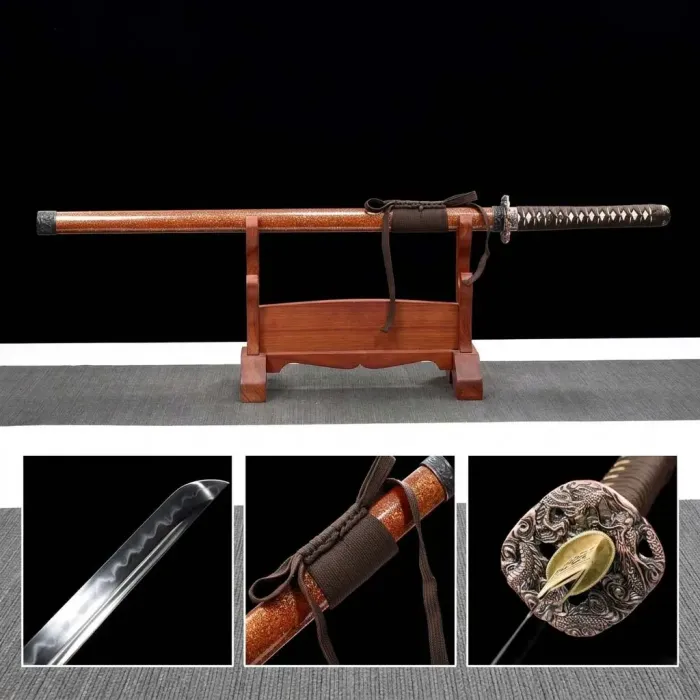
The venerable historical sword functions as a beautiful showcase of talent, but suppose you long for to reveal your particular aesthetic? Tailoring your blade is a significant journey, allowing you to craft a truly unique piece. From the hold wrapping and fitting to the barrier design and blade pattern, each detail offers a chance for individual flair. This survey delves into the world of katana adjustments, providing facts for both beginners and proficient enthusiasts desiring to leave their footprint on the classical art of the samurai.
Newcomer's Legitimate Skill
For aspirants hoping to embark on the satisfying journey of traditional blade practices , 1060 steel katanas deliver an prime entry point. This specialized grade of carbon steel meets a golden mean between budget-friendliness and performance . While never as hard as upper-echelon steels, 1060 facilitates a fair level of fine tuning , making it suited for trainees to improve the fundamentals of blade care and enjoy the charm of genuine Japanese weaponry. It’s a superb choice for establishing experience without the fiscal burden of more elite steels.
T Ten Alloy Sabers : Harmonizing Functionality and Expense
Providing for fans seeking an authentic weapon experience without surpassing the monetary limit , T10 compound katanas represent a favorable option. These blades offer a reasonable improvement in toughness compared to lower-grade alternatives, exhibiting decent edge retention and fair flexibility for initial slashing techniques. While not rivaling the eminent characteristics of elite steels like T100 or folded alloy , T10 provides a impressive blend of functionality and profitability, making them a sought-after choice for initiates and those on a tight budget .
Going past the Sharpness : Adapting Your Cutting Weapon's Fittings and Grasp
Though the refined blade is undeniably the important point of a katana, truly improving its presence lies in the exact customization of its details and handle . This operation allows craftsmen to demonstrate their unique design . Explore the sweeping possibilities: menuki - decorative ornaments that enhance visual beauty ; the hamon wrappings – often elaborately crafted ; the tsuka essence itself, wrapped in genuine ito binding ; and the fusa end piece , which can be designed from various components like gold or tusk .
- Select subjects that connect with you.
- Assess with varying resources .
- Emphasize strength for a lasting influence .
The Appeal of the Katana: Tradition, Creation, and Alloy
Such katana contains a matchless allure, steeped in ages of oriental history and ancestry. More than merely a tool of fighting , it's a figure of the warrior ethos – a fusion of expertise and management . Its development spanned many generations, with early metallic weapons evolving into the refined curvature and dangerous edge we accept today. The craftsmanship involved is truly astounding , requiring long periods of instruction to complete. The process involves a complex folding of forged iron , creating layers that boost the steel’s flexibility and cutting ability. Various schools of metalworking originated , each with their distinctive secrets and practices for achieving the flawless balance and keenness - a truly arduous pursuit.
- Primitive Katana types
- The part of the cutting armament in knight culture
- Conventional processing practices
Identifying the Fitting Steel for Your Katana Project: 1060 vs. T10
Choosing the right steel is critically important for any katana project, and the decision between 1060 and T10 can be tricky. 1060 is a popular American steel, offering a competent balance of rigidity and persistence, supplying it comparatively easy to forge. However, T10, a Oriental steel, frequently boasts improved wear longevity and can arguably achieve a greater final hardness, although it can be relatively laborious to control and requires meticulous heat conditioning. Consider your expertise and desired goals: for a learner, 1060 may be a clearer basis, while the skilled smith might appreciate swords katana the increased traits of T10.
- Effortlessness of Processing
- Edge
- Maximum Tenacity
Achieving Mastery: Complex Katana Adjustment Techniques
Refining the technique of katana adjustment extends far beyond basic sharpening. Serious connoisseurs are now probing advanced techniques to truly reveal a blade's hidden potential. This demands intricate work with the quenching mark, utilizing specialized substances for differential processing and carefully determining the design of the defense plate to optimize balance and handling. Beyond purely functional tweaks, artisans are increasingly focused on attaining unparalleled aesthetic splendor, through complex imprinting and layered finishes that truly transform a katana into a fine art.
Shaping Rough Steel into Perfection: Making a 1060 Sword
The journey starts with average 1060 metal , a strong material far away the deluxe katana it will transform . Proficient bladesmiths employ a elaborate process of uniting and crafting the primary steel, repeatedly warming it and impacting it to remove impurities and develop a symmetrical grain structure. This painstaking process, often persisting for cycles, builds the essential hardness and flexibility characteristic of a real Japanese edge . Further heat procedures , including methodical hardening and tempering , are imperative to achieve the targeted equipoise of sharpness, longevity and charm .- Overlaying: Reduces impurities and forms grain structure.
- Hammering: Creates the steel into the initial blade form.
- Heat Treatment: Defines the final hardness and flexibility.
The Continuing Pull of the Katana: Comprehensive Review of Metalwork and Tailoring
Each established katana stays a captivating symbol representing Japanese civilization , its magnetism far outstripping mere military gear. Forged from tamahagane steel and often featuring intricate patterns , the technique of creation itself is a respected art. Beyond the primary craftsmanship, the ability to adapt a katana - from the quench mark to the shaft wrapping and fitting - provides for a honestly individual demonstration for both curators and participants alike. This confluence of classical steelwork and boundless personalization creates the katana's continued widespread acceptance across the universe.